

An Appalachian Winter

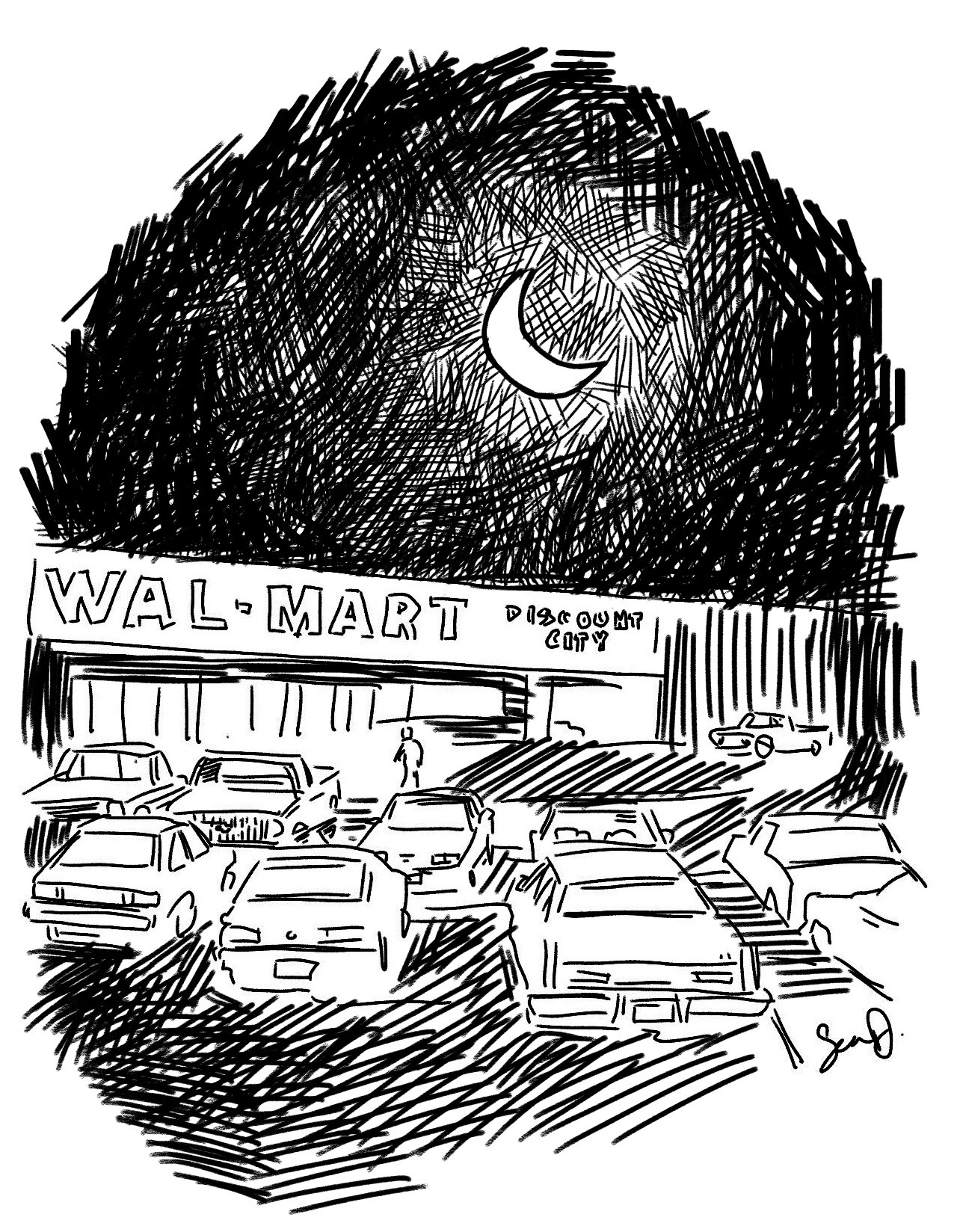
Visiting an Appalachian Walmart at 8 o’clock in the evening is unlike any other experience.
Rural Appalachian dwellers are unique unto themselves. Cautious of outsiders. Not always friendly. They have trust issues.
Trust is a commodity among such strong and self-sufficient people. Distrust of strangers is their first line of defense.
Understandably so. Namely, because cyclical poverty in the Appalachian region hangs around like a bad cold. One out of every four kids in Appalachia lives below the poverty line. One out of every five or six houses within these mountains is food insecure. The leading killer in the rural Appalachian health crisis is overdose.
There aren’t many things in life worth trusting.
Which is why there isn’t much chatter in the Walmart aisles. Not even from the children. Everyone’s faces are sort of tired. There is a weighted melancholy in the air.
Many shoppers are wearing what amounts to ragged pajamas. Some children aren’t wearing coats, although it’s snowing.
There is one young mother, with four children in tow, she is wearing flip flops.
Her hair is violently red. She is lean, wearing short sleeves, with fair skin that looks so cold the freckles seem to be jumping right off her arms.
She doesn’t think anyone notices her as she wanders each aisle, her quiet children following dutifully beside her. She doesn’t think anyone notices her eyeing the price tags, performing incredible feats of mental math which only the Have-Nots are capable of.
But someone is watching her.
Someone is watching when her youngest tries on shoes in the shoe department because his are tattered.
Someone is watching when she buys a pair of adult work gloves because these are cheaper than children’s mittens.
Someone is watching when her oldest daughter begs her mom for deodorant because she is embarrassed about stinking at school.
When the mother passes the dairy section, an older woman is waving her arm, flagging her down.
“Excuse me,” The older woman says. “Is your name…?” Then she says the young woman’s name.
A jolt of icy adrenaline shoots through the mother’s veins. How does this lady know her name? Why is she stopping her in the middle of the store? Something must be wrong.
“That’s my name,” says the mother. “Why?”
The lady smiles. “Nothing’s wrong, ma’am. The man said you’d have super red hair and that I couldn’t miss you.”
The young woman is confused. “What are you talking about?”
“That man,” says the lady, pointing toward the doors. “He just left. Said he knew you.”
The woman sees no man at the door.
“He left these gift cards for you. He was from some church, he said. Said you wouldn’t accept them from him, not unless some random person gave them to you.”
The woman’s face hardens. Distrust wells up inside her. Her Appalachian heritage is showing—if something sounds too good to be true, run like hell.
“What?” says the young mother.
The lady hands her a deck of gift cards. “He made me promise to stand here and wait for you.”
The woman is afraid to touch them. This has to be an evil trick. But it’s not.
Each gift card is loaded with $500. There are 10 cards in total. And as I write these words, the young mother still has not exhausted the balance.
“This story can’t be true,” says the skeptic.
Well, I’m sorry, but you’ll just have to trust me.
I wa 12 before we had indoor plumbing.
Outside, in the summer, we had a water hose hooked to a faucet and put over the top of a wooden enclosure for privacy to shower. When it got cold, we bathed like Dolly Parton; First you take a pan of water and soap and a rag, and wash down as far as possible. Then you wash up as far as possible. Then you wash possible." Mom washed our clothes in a wringer type washer and hung them out to dry. She worked in a shirt factory during the week and did laundry and house cleaning on Sat. We went to bed just as she was mopping the floors. My mom and grandmothers made all my outer wear, even in high school, including my first prom dress.
We were poor but clean and tidy. My brothers and I made good grades, never got in trouble and grew up to be business owner (oldest), AF career (youngest), and I was an Army spouse, who worked over 30 years in insurance in 3 states. We grew up in LA (Lower Alabama). It was much like living in Appalachia. I never felt deprived. We were loved and our neighbors were like extended family. Everyone was in the same boat. No one was rich, but we all helped each other. I would not trade my childhood with that of anyone who grew up having it all. We had things money could never buy.
I have heard of people following someone this time of year that would follow a shopper like the mother in your story. The person would start with a load of groceries and whatever they looked for but didn't take because it was too expensive. Games, shoes, clothes and even a few treats. They would check them out and tell the clerk who they were for. On the receipt it would just have the person's name and three words "Hope this helps." Then they would leave. I am sure they would watch from a distance, but these people don't do it for Likes, clicks on social media, they do it for reasons only known to them. Happy holidays everyone.